Ceramics, BFA
Program Details
- Location
- Akron Campus
- Level
- undergraduate
- Academic Pathway
- major
- Degree/Program Type
- Bachelor of Fine Arts
- Format
- In-person
- Course Info
- Ceramics, BFA
- College
- Buchtel College of Arts & Sciences (BCAS)
- School/Department
- Mary Schiller Myers School of Art
Program Contact
- Anthony Samangy
-
Director
330–972–2383
Overview
Build your artistic voice through clay
The Bachelor of Fine Arts in Ceramics at The University of Akron combines hands-on making with experimentation, critical thinking and an understanding of ceramics across history and contemporary practice.
At the Myers School of Art, you’ll learn by doing. Explore handbuilding, wheel throwing, slipcasting, glaze formulation, firing methods and digital technologies while developing the technical skills and creative confidence to make work that is distinctly your own.
Your studies prepare you to pursue a professional studio practice, opportunities in the visual arts or graduate study in ceramics and fine art.
Admissions Requirements
Students must meet the general admissions requirements of The University of Akron.
Career Outcomes
Graduates of the Ceramics BFA may pursue:
Studio artist careers
MFA programs in ceramics or sculpture
Positions in galleries, residencies, and arts nonprofits
Teaching, fabrication, or museum education roles
Entrepreneurial work in functional or conceptual ceramics
Additional Program Information
Distinctions
- Large open studio spaces programmed to facilitate collaboration and a sense of community.
- More than 12 kilns able to fire oxidation, reduction and raku.
- A highly functional fully stocked glaze laboratory.
- Clay making facilities replete with a wide range of ceramics materials.
- Access to cutting edge technology which include 3D stereolithographic printing, overglaze decal printers and more fabrication technologies in collaboration with our maker space.
- Access to a wide range of exhibition and retail opportunities.
- Specialized courses offered in a wide range techniques and conceptual topics.
- Annual opportunities to atend National Council for Education of Ceramic Arts (NCECA)
More ways to make
Explore the studio access, firing methods and technologies that give you more ways to experiment, create and develop your practice.
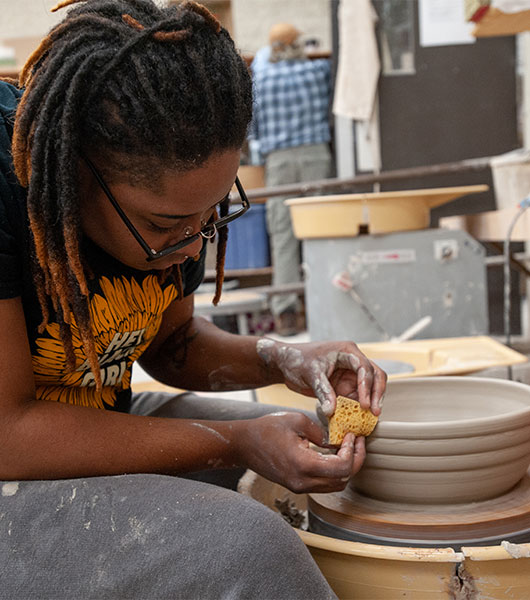

Studio access
Work beyond class time with 24-hour access to large, open ceramics studios built for making and collaboration.

Traditional meets digital
Build skills in handbuilding, wheel throwing and slipcasting while exploring 3D printing, decal printing, laser cutting and vinyl cutting.

Explore the firing process
Gain experience with more than 15 kilns and firing methods, including oxidation, reduction, salt and soda, raku and smoke firing.
About the Ceramics program
Learn about the program’s approach to ceramics, its purpose and the skills students develop.
The ceramics program at the Myers School of Art is built on the belief that students learn through doing: building hand skills through practice, thinking through sketching and growing as artists through rigorous practice.
Education pioneer John Dewey wrote in Art as Experience, “we do not learn from experiences, we truly learn by reflecting on our experiences.” In keeping with this thinking, the curriculum explores the history of ceramics and uses that knowledge to consider the future of the medium.
Clay and ceramics have developed alongside humanity since the earliest periods of civilization. During that time, knowledge has been passed on through demonstration, practical instruction and the exchange that comes with discussing new ideas.
The program explores art making by considering the historical and cultural meaning of ceramic materials, as well as the importance of objects. Students draw on their personal experiences with the world of things and consider new possibilities and uses for such items. Lectures, demonstrations, hands-on experiences and experimentation help students develop the knowledge of processes and skills necessary to produce their ceramic work.
The ceramics program at The University of Akron’s Myers School of Art offers a comprehensive, forward-thinking undergraduate education designed to prepare students for work as visual artists and independent thinkers. The program is structured so students may consider careers in ceramics or further graduate education in the visual arts.
The program offers students experience with a wide range of ceramic techniques and firing methods. Students receive instruction and support as they learn and develop their personal artistic voice.
Students majoring in ceramics at The University of Akron will develop:
- Skills for a future in the field of fine art.
- A focused understanding of the contemporary continuum of clay.
- Knowledge of the historical uses, importance and aesthetics of ceramics.
- A tactile understanding of clay materials and their potential.
- Problem-solving skills, methods of critical thinking and ideation, and the ability to talk about artwork.
- Reflective ways to self-evaluate and consider the development of their own artwork.
- The ability to transfer tactile skills to other media while drawing on skills from other areas.
- The ability to operate and control a wide range of ceramics firing temperatures and atmospheres in various kilns, including bisque, glaze, oxidation, reduction, salt and raku firing.
- Skills in building ceramic forms by hand, on a potter’s wheel, through slipcasting and by employing digital technology.
- Knowledge of the formulation of clay bodies, glazes and ceramic coatings for a wide range of color choices.
- The ability to synthesize assignments and individual ideas into a unique voice and style for producing individual ceramic artwork.
The ceramics program at the Myers School of Art is built on the belief that students learn through doing: building hand skills through practice, thinking through sketching and growing as artists through rigorous practice.
Education pioneer John Dewey wrote in Art as Experience, “we do not learn from experiences, we truly learn by reflecting on our experiences.” In keeping with this thinking, the curriculum explores the history of ceramics and uses that knowledge to consider the future of the medium.
Clay and ceramics have developed alongside humanity since the earliest periods of civilization. During that time, knowledge has been passed on through demonstration, practical instruction and the exchange that comes with discussing new ideas.
The program explores art making by considering the historical and cultural meaning of ceramic materials, as well as the importance of objects. Students draw on their personal experiences with the world of things and consider new possibilities and uses for such items. Lectures, demonstrations, hands-on experiences and experimentation help students develop the knowledge of processes and skills necessary to produce their ceramic work.
The ceramics program at The University of Akron’s Myers School of Art offers a comprehensive, forward-thinking undergraduate education designed to prepare students for work as visual artists and independent thinkers. The program is structured so students may consider careers in ceramics or further graduate education in the visual arts.
The program offers students experience with a wide range of ceramic techniques and firing methods. Students receive instruction and support as they learn and develop their personal artistic voice.
Students majoring in ceramics at The University of Akron will develop:
- Skills for a future in the field of fine art.
- A focused understanding of the contemporary continuum of clay.
- Knowledge of the historical uses, importance and aesthetics of ceramics.
- A tactile understanding of clay materials and their potential.
- Problem-solving skills, methods of critical thinking and ideation, and the ability to talk about artwork.
- Reflective ways to self-evaluate and consider the development of their own artwork.
- The ability to transfer tactile skills to other media while drawing on skills from other areas.
- The ability to operate and control a wide range of ceramics firing temperatures and atmospheres in various kilns, including bisque, glaze, oxidation, reduction, salt and raku firing.
- Skills in building ceramic forms by hand, on a potter’s wheel, through slipcasting and by employing digital technology.
- Knowledge of the formulation of clay bodies, glazes and ceramic coatings for a wide range of color choices.
- The ability to synthesize assignments and individual ideas into a unique voice and style for producing individual ceramic artwork.